BOSTON — For most of the last decade, Massachusetts was one of the best places in America to start a business. From 2010 to 2019, only Utah had a higher rate of net new employer businesses. The state's innovation economy was the envy of the country — anchored by world-class universities, a booming life sciences sector, and a labor force that attracted talent from around the world.
That era is over.
A devastating new report from the Pioneer Institute finds that Massachusetts now has the lowest average rate of net business formation of any state in the country — dead last, 50th out of 50 — over the period from 2022 through the third quarter of 2024.
The state lost a net 17,549 employer businesses across nine consecutive quarters of negative formation. Its net business formation rate: 0.05%. The national average: 0.60%.
While the rest of the country experienced an unprecedented surge in entrepreneurship coming out of the pandemic, Massachusetts went backwards. And the businesses that aren't closing are packing up and leaving.
Heading south
Massachusetts lost a net 70 firms to other states in 2023 — the worst single year of business migration since at least 1994. From 2020 to 2023, the state lost 149 firms in total, with the exodus flowing primarily to Florida, Texas, and North Carolina.
The pattern is unmistakable. The states absorbing Massachusetts businesses have been cutting taxes, slashing regulations, and making it cheaper to operate. Idaho — the fastest-growing state for new establishments at 58.1% — has cut or simplified over 95% of its state regulations since 2019.
Massachusetts, under Governor Maura Healey, went the other direction. A surtax on incomes above $1 million. Aggressive climate mandates through BERDO and Net Zero Carbon Zoning. Rising housing costs that make it harder to recruit and retain workers. A regulatory environment that the Pioneer Institute's executive director, Jim Stergios, says is sending a clear signal.
"Massachusetts' dramatic decline in business formation strongly suggests that investors and entrepreneurs are choosing not to build here," Stergios said.
It's not just the data telling that story. One Boston-area business owner who spoke to Mass Daily News on condition of anonymity said the decision to register out of state was straightforward.
"Massachusetts charges $500 just to form an LLC, there's zero privacy protections for owners, and frankly, I don't want my tax dollars going toward migrant programs and expensive climate policies I didn't vote for," he said. "I registered in Wyoming. It took ten minutes and cost a fraction of what Massachusetts wanted. A lot of people I know are doing the same thing."
Wyoming charges $100 to form an LLC, offers full anonymity for business owners, and has no state income tax. It's become one of the most popular destinations for entrepreneurs who want to start a business without the regulatory overhead — or the political baggage — that comes with a Massachusetts filing.

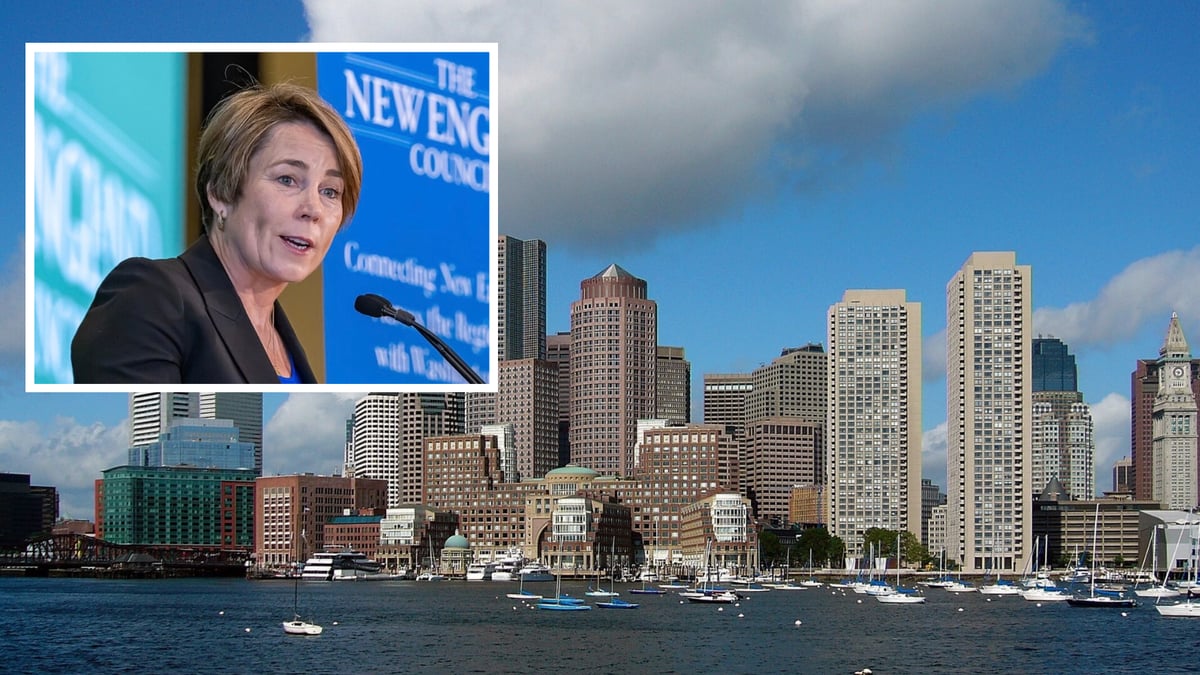
Governor Maura Healey. Under her watch, Massachusetts has fallen to dead last in the nation for business formation. Photo: Joshua Qualls / Office of the Governor.
The numbers are ugly everywhere you look
MASSDAILYNEWS
STAY UPDATED
Get Mass Daily News delivered to your inbox
ADVERTISEMENT · Interested in advertising?
ADVERTISEMENT · Interested in advertising?
The decline cuts across nearly every sector of the economy.
Healthcare and education — historically two of the Commonwealth's crown jewels — lost nearly 1,800 establishments between Q1 2022 and Q3 2025. Nationally, that sector grew 16.2%. In Massachusetts, it shrank.
Professional, scientific, and technical services — the innovation economy Massachusetts is supposed to be known for — grew just 10.2%, compared to 16.9% nationally. Every single New England competitor outperformed Massachusetts: Connecticut at 35.6%, New Hampshire at 30.7%, Vermont at 29.4%, Maine at 17.2%, and even New York at 19.7%.
Construction grew 0.6% in Massachusetts. Nationally: 7.2%. Trade, transportation, and utilities shed 515 establishments.
Total establishment growth since Q1 2020: 13.0% — ninth worst in the country. North Carolina grew 31.1%. New Hampshire grew 25.4%. Florida grew 21.5%. Texas grew 17.3%.

Boston's Financial District. Office vacancy downtown has climbed to roughly 25%, and commercial property values have fallen at a rate not seen since the 2008 financial crisis. Photo: Nelson48 / Wikimedia Commons.
Downtown is hollowing out
The business formation collapse is playing out in real time on the streets of downtown Boston.
Office vacancy across greater Boston hit 23.9% in Q4 2025, according to Colliers — roughly 10 percentage points above the historical average and 16 points above the pre-pandemic low. In the core of downtown, roughly one in four office spaces sits empty.
The financial hit is staggering. A Boston Policy Institute report found that office building assessed values fell 9% in fiscal year 2025 — a decline comparable only to the 2008 financial crisis and the dot-com bust — with another 6% drop projected for 2026. Office buildings that sold traded at 30% to 50% below their assessed values.
The city is projected to lose $1.7 billion in property tax revenue over five years. Property taxes make up 71% of Boston's $4.8 billion budget. The math doesn't require a degree from MIT.
The pipeline is drying up too
ADVERTISEMENT · Interested in advertising?
ADVERTISEMENT · Interested in advertising?
It's not just established businesses leaving. The next generation of companies isn't forming.
Business applications in Massachusetts grew 37.0% from 2019 to 2025 — barely more than half the national rate of 60.5%. For high-propensity applications — the ones most likely to become actual employer businesses — Massachusetts ranked 39th nationally, with growth of 20.9% against a 27.8% national average.
New Hampshire: 38.7%. Texas: 36.4%. North Carolina: 36.3%. Connecticut: 36.2%. Delaware: 131.8%.
The entrepreneurs who would have started businesses in Massachusetts are starting them somewhere else.

The Boston skyline with the State House at center. Massachusetts has lost 35,000 private sector jobs since January 2020 — one of only six states that haven't recovered. Photo: NewtonCourt / Wikimedia Commons / CC BY-SA 4.0.
35,000 jobs and 180,000 residents — gone
The consequences are already here. Massachusetts is one of just six states that have not recovered to pre-pandemic levels of private sector employment, with roughly 35,000 fewer jobs than in January 2020.
More than 180,000 net domestic residents have left since April 2020. A 2024 survey found that job availability was one of the top two factors people aged 20 to 30 considered when deciding whether to stay or leave the state.
"Massachusetts entered the pandemic as one of the country's most innovative economies," wrote Aidan Enright, the report's author. "That momentum proved to be fragile."
Fragile is one word for it. The surtax told high earners they weren't welcome. The housing market told workers they couldn't afford to stay. The regulatory burden told small businesses it wasn't worth the hassle. And the states next door — New Hampshire, Connecticut, even Vermont — rolled out the welcome mat.
Second in America a decade ago. Dead last today. The numbers don't lie, even if Beacon Hill won't read them.
Loading Comments